
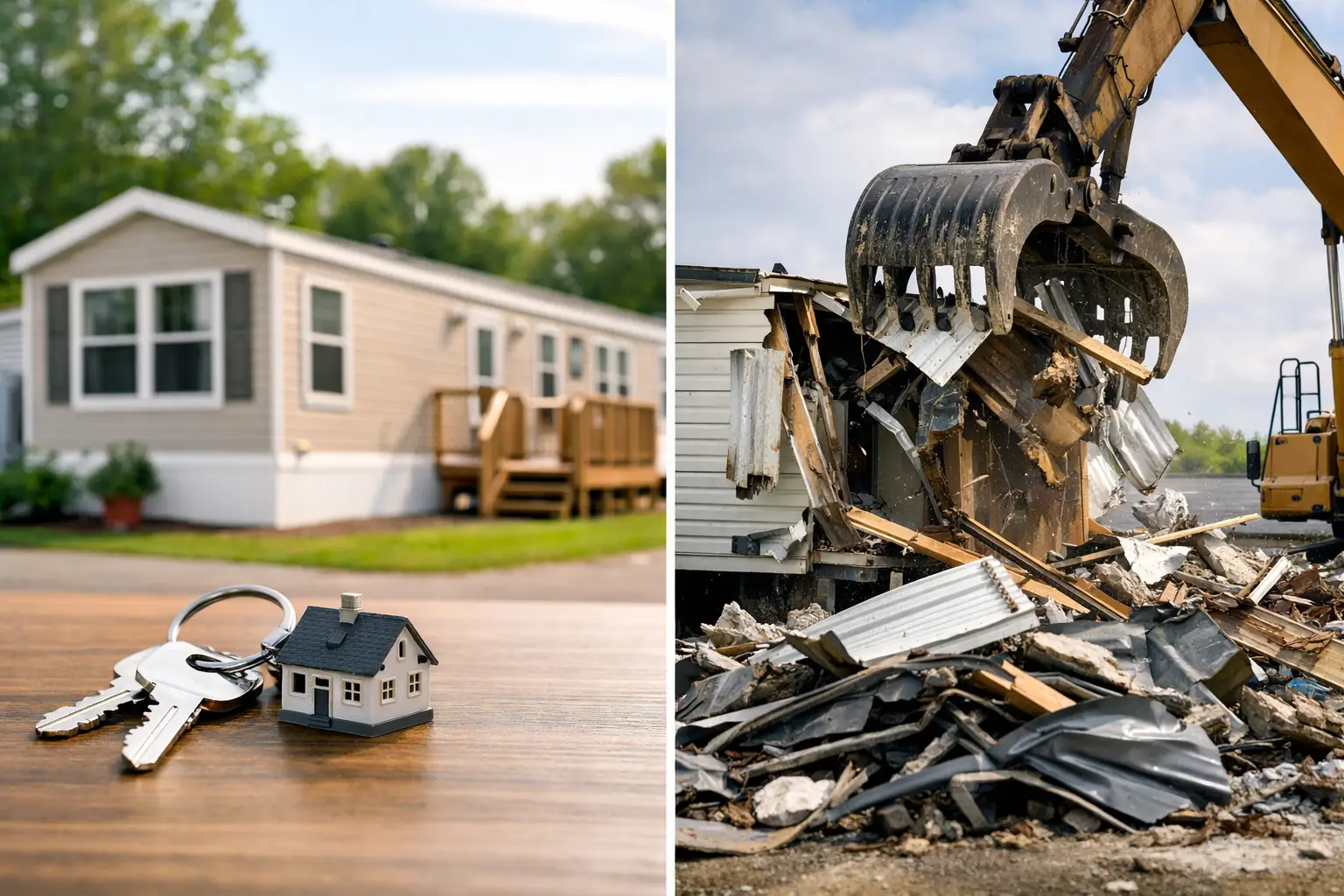
That old mobile home sitting on a lot can turn into a bigger expense fast. If you are weighing selling mobile home vs scrapping it, the right answer usually comes down to four things – condition, title, location, and how quickly you need the problem solved.
Some owners assume scrapping is the only option once a home has leaks, soft floors, missing skirting, old plumbing, or park pressure to remove it. That is not always true. In many cases, a mobile home that looks rough still has resale value to the right buyer, especially if someone else is willing to handle the paperwork, transport questions, and buyer outreach.
Selling mobile home vs scrapping it: what actually decides?
This decision is less about emotion and more about numbers and logistics. A mobile home can be ugly and still be worth selling. On the other hand, a home can look decent from the outside and still make more sense to scrap if the legal or structural issues are too far gone.
Start with the title. If you have a clear title, selling is usually much easier. If the title is missing, signed incorrectly, still in a deceased relative’s name, or tied up in probate, that does not always kill the deal, but it does affect your options. Scrapping may sound simpler, but even disposal can require proof of ownership, permit compliance, and coordination with the park or county.
Next is the home’s location. A mobile home in a park with strict age rules or removal deadlines may have limited resale options unless a buyer can move it quickly. A home on private land may be easier to market if the buyer has more flexibility. If the home must be moved, transport costs matter. Those costs can be high enough to reduce the number of buyers willing to take it on.
Then look at the condition honestly. Cosmetic damage is one thing. Major frame damage, severe water intrusion, black mold throughout, fire damage, or a collapsed roof is another. The more serious the structural problems, the more likely scrapping moves from backup plan to practical answer.
When selling usually makes more sense
If the home has a transferable title, basic structural integrity, and a realistic path to a buyer, selling is often the better financial move. Even homes that need work can attract cash buyers, handymen, landlords, or park-approved buyers looking for a lower entry price.
This matters because scrapping is not free. Owners are often surprised by the actual cost to tear down and haul away a mobile home. You may have demolition labor, dumpster fees, transport, landfill charges, permit costs, utility disconnects, and cleanup. If asbestos, old insulation, or other hazardous materials are involved, the price can climb further.
Selling can also save time in ways people do not expect. A direct buyer may purchase the home as-is, which means no repairs, no cleaning, no showings, and no waiting around for a retail buyer who may never close. If you are behind on lot rent, dealing with an inherited home, facing repossession, or trying to avoid more monthly costs, certainty can matter more than holding out for the perfect number.
There is also a middle ground many sellers miss. You do not always have to list the home yourself and manage dozens of calls, lowball messages, and no-shows. In some situations, a local mobile home specialist can either buy the home directly or help source a buyer through existing community networks. That can keep the home out of the scrapyard without putting the entire burden on you.
When scrapping may be the better option
Sometimes the numbers are just too tight. If the home cannot legally stay where it is, cannot be moved economically, and needs more repair than the market will support, scrapping may be the cleaner decision.
This happens often with very old homes in parks that no longer accept homes of that age. It also comes up when a home has major floor failure, severe roof collapse, stripped-out interiors, or storm damage that leaves little salvage value. If the frame is compromised or key systems are destroyed, most buyers will pass.
Another factor is timing. If a park has given a firm deadline and there is no realistic path to a sale before that date, scrapping may reduce ongoing penalties or legal exposure. The same applies if code violations are piling up and the cost of delay is getting worse each month.
Still, owners should be careful not to assume a bad-looking home has no market. A lot of mobile homes get scrapped simply because the owner does not know who buys problem homes. Before paying for demolition, it is worth finding out whether a local buyer will take it as-is.
The real cost of scrapping a mobile home
Scrapping sounds final and simple. In practice, it can be a project.
You may need approval from the park, county, or landowner. Utilities may need to be shut off and documented. Permits may be required for demolition or removal. Then there is labor. Depending on size, access, and condition, removing a single-wide or double-wide can cost far more than many owners expect.
There is also the issue of what gets left behind. Steps, porches, skirting, tie-downs, HVAC units, debris piles, and old appliances may not be included in the initial quote. If the crew only removes the shell, the owner can still be stuck with site cleanup.
And if your goal is simply to stop the financial bleeding, scrapping may not get you there faster than a direct sale. In some cases, selling to a cash buyer means the home is gone without the owner paying money out of pocket to make that happen.
How to compare your two options without guessing
A practical way to decide is to compare net outcome, not just price.
If you sell, ask what you will actually walk away with after considering repairs, cleaning, marketing time, title work, lot rent, and any transport issues. If you scrap, ask for the full removal cost in writing, including permits, disposal, and final site cleanup.
Then look at your deadline. If you need the home dealt with this week, your best option may not be the one with the theoretical highest value. It may be the one that gives you a firm answer and a clear closing date.
This is especially true in Central North Carolina, where park rules, land situations, and title issues can change the equation quickly. A seller in Greensboro may have a very different path than a seller in a rural county with private land. That is why local experience matters. A buyer who understands mobile home titles, park communication, and move logistics can often save a deal that a general buyer would walk away from.
A few North Carolina issues that change the answer
North Carolina mobile home sales are not always straightforward. Titles need to be handled correctly. If the home is in a park, park management may have to approve the buyer or the home’s continued placement. If the home must be moved, setup and transport rules can become a major factor.
Inherited homes can be even more complicated. If you are an out-of-state heir trying to figure out whether to sell or scrap, the last thing you need is a drawn-out process full of dead ends. In that situation, a direct buyer can be valuable not just because of the offer, but because they know how to work through the paperwork and next steps.
That is one reason many sellers in the Triad choose a company like Triad Mobile Homes. The goal is not to make the process feel fancy. It is to get a fair cash offer, remove the usual friction, and help the seller move on without repairs, listings, or guesswork.
The better question is not what the home was worth
It is what your best option is today.
A mobile home that would have sold easily five years ago may now face stricter park rules, higher moving costs, or heavier repair burdens. At the same time, a home you think is junk may still have enough value for a cash buyer to take it off your hands as-is.
If you are stuck between selling mobile home vs scrapping it, do not start with assumptions. Start with facts – clear title status, actual condition, park or land restrictions, and the real cost to remove it. Once you have those, the right path usually becomes obvious.
And if speed matters, the simplest move is often the smartest one: get a real offer, compare it against the true cost of scrapping, and choose the option that lets you put the problem behind you for good.